
This post and episode may contain affiliate links. This means that if you make a purchase after clicking some of the links below, although your cost doesn’t change, I may receive a small commission. For more information, see my privacy and disclaimers.
But it’s in moments like these that really call us to stop and take a hard, honest look at our own hearts. It’s a call to ask ourselves…
- Am I responding to conflict in a way that honors Jesus, or am I fueling the same hate I say I stand against?
- Am I reflecting Christian love, or am I becoming part of the problem instead of pointing to Christ?
- Am I standing for truth, but doing it in a way that leaves people wounded instead of drawing them toward Jesus?
These aren’t easy questions, but they’re necessary ones, and I’m breaking them down in this week’s show.
Why The Weight of Our Words Matters
Ephesians 4:29–30 (AMP) is clear and convicting:
“Do not let unwholesome, foul, profane, worthless, vulgar words ever come out of your mouth, but only such speech as is good for building up others, according to the need and the occasion, so that it will be a blessing to those who hear you speak. And do not grieve the Holy Spirit of God [but seek to please Him], by whom you were sealed and marked [branded as God’s own] for the day of redemption, the final deliverance from the consequences of sin.”
Yes, we’re called to stand for God’s truth. But how we stand for it matters.
If we claim to be in partnership with God, then we must agree to treat everyone — fellow Christians and non-believers alike — in a way that reflects the light of Jesus.
Why Self-Reflection is so Important
We all have strong opinions, and sometimes the ugliness in the world stirs up some pretty big emotions. But how we respond to these emotions and the world matters. In fact, Hebrews 12:14–15 reminds us,
“Pursue peace with everyone, and holiness, since no one will see God without it. Watch carefully that no one falls short of God’s favor, that no well of bitterness springs up to trouble you and throw many others off the path.” The Voice
Our bitterness, anger, and frustrations don’t stay contained when we jump on social media and add to all the loud chaos. It spreads to others, and unfortunately, they often push people further away from the God we’re trying to represent.
Which is why humbling ourselves, pausing, and taking a real look inside is so crucial. We can’t excuse harsh words, quick tempers, or un-Christian reactions with, “Well, that’s just the way the world is.”
Christ calls us to respond to conflict differently from the world. He calls us to rise above the noise and walk in Christian love above all else.
What Jesus Teaches Us About Living in a Dark World
Jesus never promised us an easy life. In fact, He tells us in John 16:33,
“I have told you all this so that you may have peace in me. Here on earth you will have many trials and sorrows. But take heart, because I have overcome the world.” NLT
Our hope isn’t in shouting louder than the world. It’s not in “winning” every argument. Our hope is in Jesus — the Vine who calls us to stay connected so that we can bear fruit in a dark world.
“Yes, I am the vine; you are the branches. Those who remain in me, and I in them, will produce much fruit. For apart from me you can do nothing. 6 Anyone who does not remain in me is thrown away like a useless branch and withers. Such branches are gathered into a pile to be burned.” John 15:5-6 NLT
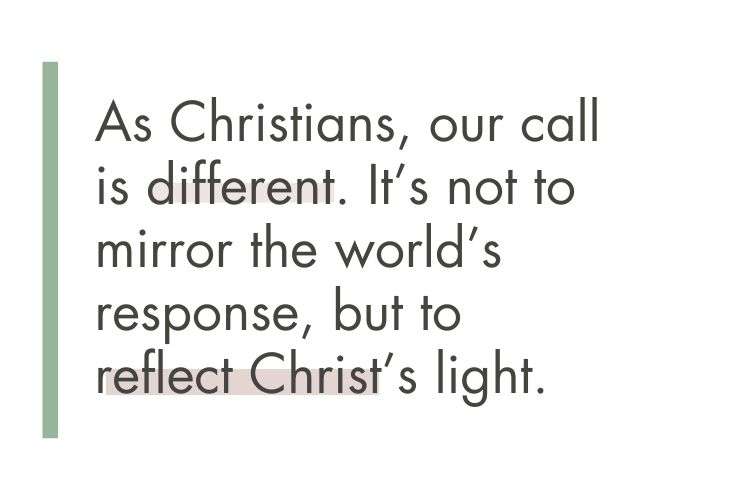
Conflict and violence will continue. But as Christians, our call is different. It’s not to mirror the world’s response, but to reflect Christ’s light.
How to Respond to Conflict as a Christian
That’s exactly what I’m unpacking in this week’s podcast episode: How to Respond to Conflict as a Christian.
This isn’t about pointing fingers. It’s about a deep, honest heart check.
Because if we’re not careful, our responses can bring sorrow to the Holy Spirit and make us look more like the world than like Jesus.
“And do not bring sorrow to God’s Holy Spirit by the way you live. Remember, he has identified you as his own, guaranteeing that you will be saved on the day of redemption.” Ephesians 4:30 NLT
Inside this week’s show, I’ll walk you through three key areas every Christian needs to evaluate to ensure their response to conflict actually honors God.
Because if we don’t pause to ask these questions now, we risk letting bitterness, division, and hate take root in us.
- 00:00 Introduction
- 02:55 Step 1: Set down our differences to see what the most important thing about us is
- 08:10 Step 2: Check your motivation behind your response.
- 16:03 Step 3: Go to God first and foremost
- 21:00 How to Shine for God in a dark world
- 24:50 What to do when we make mistakes as a Christian
[Check out everything mentioned in the show here.]
More Ways to Enjoy the Show
Would you rather listen to the audio? I got you, my friend. Just hit the play button below.
Rate and Review the Show
“I love Tammy and A Faithful God Podcast!.” If that sounds like you, please consider rating and reviewing my show!
This helps me support more women — just like you — grow closer to God and learn how to apply God’s Word to their life.
Simply click here, scroll to the bottom, tap to rate with five stars, and select “Write a Review.”
Then be sure to let me know what you loved most about this episode!
Mentioned in TODAY’S show
Unlocking Your Best Year — Choosing a Focus for the Year
What it Means to Have a Teachable Heart