



For your convenience, this post may contain affiliate links. This means that if you make a purchase after clicking on some links below, though your cost does not change, I may receive a small commission. For more information, see our privacy and disclaimer page.
It’s something I’ve seen again and again — women who genuinely want to grow closer to God, women who love Him deeply, who’re trying, who don’t want to give up.
Yet they’re quietly left questioning, “Why does prayer feel so hard?”
But what if you’ve been trying to solve the wrong problem all along?
So before you make another plan or download another reading plan, I want to take some of that pressure off. Because starting over with God doesn’t begin with a better plan. It begins with understanding what starting over actually means to Him.
Why Do I Keep Starting Over With God?
Most women keep starting over with God — not because they lack self-discipline — but because they’ve attached a painful meaning to every missed day. And that guilt makes it harder to come back, and the cycle repeats.
For many women, spiritual growth feels like a cycle that keeps repeating itself.
You get inspired from a Sunday morning sermon, join a Bible study and tell yourself that this time, things are finally going to be different.
And for a while… they are.
You’re spending more time in prayer, opening your Bible more consistently, and feeling encouraged by what God is teaching you.
But then… life gets busy.
A schedule changes, someone needs your attention, or an unexpected challenge lands on your doorstep.
And before you know it, guilt starts whispering, “You’ll never get your prayer life right.”
So you decide to start over… again.
The longer this pattern repeats, the less it feels like a consistency problem and the more it feels like a personal failure.
Instead of giving yourself some grace, you begin telling yourself,
- “I need to try harder.”
- “I need more discipline.”
- “Why can’t I get this together?”
The longer this cycle continues, the easier it becomes to believe the problem is you.
And that’s where I see so many women get stuck.
Because the truth is, this was never really about consistency. In fact, consistency is just a symptom.
The real issue — the one that keeps the cycle going — is what you’ve started to believe about yourself.
I dig deeper into the consistency side of this in Why Can’t I Stay Consistent With God? But here, I want to focus on what happens every time you have to begin again.
Why Does Starting Over With God Feel Like Failure?
Here’s where it gets interesting, and where the cycle usually gets worse.
When we keep having to start over with God, most of us automatically assume that we need more discipline, more commitment, and more willpower.

So we respond the way most people do when something isn’t working — we try to fix it.
We create a better plan, set stricter goals and promise ourselves that this time will be different.
But if trying harder was the solution, it would’ve worked by now.
That’s not meant to discourage you. It’s meant to free you.
Because the problem with your prayer life isn’t a lack of effort. The problem is what you think your time with God should look like.
What’s Really Keeping You Stuck in the Starting-Over Cycle?
Now let’s talk about something that doesn’t get discussed nearly enough.
Somewhere along the way, many of us have picked up unrealistic expectations that God never asked us to carry.
Expectations like…
- I shouldn’t miss a day.
- I should always feel connected to God.
- I should always know what to say when I pray.
- If I were serious enough, I’d stay consistent.
- If I really loved God, this wouldn’t be so hard.
And when we can’t live up to those expectations, we assume we’re the problem.
Then every missed day starts to feel like failure, which in turn, leads to more guilt. And guilt has a way of making us avoid the very thing we’re missing.
Before long, we’re not just missing a day or two with God. We’re carrying deep shame about it as well.
But the issue isn’t the missed day. The issue is what we’ve made that missed day mean.
Consider for a moment what your real, everyday life looks like.
You’re balancing responsibilities, relationships, work, caregiving, appointments, unexpected interruptions, and a hundred different things pulling at your attention.
And yet you’re likely expecting yourself to maintain a perfect spiritual routine in the middle of all of it.
And when it doesn’t happen the way you think it should, you think, “Maybe I’m not cut out for this Christian life.”
But that isn’t truth.
The issue isn’t that you’re not trying hard enough.
It’s that you’ve been carrying expectations about prayer that won’t help you grow closer to God in the first place.
Because pressure produces guilt — not growth. And guilt doesn’t create lasting change.
What Does the Bible Say About Starting Over?
Here’s what I love about this question. God answered it long before any of us opened a reading plan.
Lamentations was written during one of the darkest moments in Israel’s history. Jerusalem had fallen, and the writer was surrounded by loss on every side. And right in the middle of all that grief, he wrote this,
“The faithful love of the LORD never ends! His mercies never cease. Great is his faithfulness; his mercies begin afresh each morning.”
Lamentations 3:22–23 NLT
Notice that word… afresh. God didn’t design a relationship where you get one start and spend the rest of your life trying not to mess it up. He built new beginnings into every single morning.
Consider what that means when you open your Bible after it’s been sitting on the nightstand for three weeks. You aren’t sneaking back in through the side door, hoping God didn’t notice how long you were gone. You’re stepping into a morning He already planned to meet you in.
Starting over isn’t a detour from God’s plan. It’s part of it.
And Jesus said the same thing in His own way.
One of my favorite passages from Jesus is found in Matthew 11:28–30,
“Come to Me, all who are weary and burdened, and I will give you rest.”
Matthew 11:28 NIV
Notice what Jesus doesn’t say.
- He doesn’t say, “Come to me after you’ve completed your reading plan.”
- He doesn’t say, “Come to me once you’ve prayed every day for a month.”
- He doesn’t say, “Come to me when you finally have your spiritual life together.”
- And He doesn’t say, “Come to me once you’ve proven you’re serious about your relationship with me.”
He simply says, “Come to Me.”
That’s it.
But all too often, we treat our relationship with God like a performance review.
We evaluate ourselves based on how many days we’ve read our Bible, how often we’ve prayed, whether we’ve stayed meticulously on track, and whether we’ve fallen behind.
But Jesus never invited us into performance. He invited us into relationship.
His invitation was never, “Get your act together and then come.”
His invitation was simply, “Come.”
Even when you’re tired. Even when you’ve fallen off. And even when you feel like you’re starting over… again.

Is It Normal to Feel Like You’re Always Starting Over With God?
Yes.
So the next time you find yourself thinking, “I need to do better,” pause for a moment.
Instead of asking, “What’s wrong with me?” try asking, “What if I’ve been relying on the wrong solution?”
You don’t need more pressure. You don’t need a stricter routine. And you don’t need another promise that you’ll finally get it right this time.
You simply need a different approach to spending time with God.
- One that focuses on relationship before routine.
- One that leaves room for real life.
- And one that measures success by your willingness to keep coming back to God — not by whether you’ve managed to maintain a perfect routine.
Because healthy spiritual growth is rarely built through pressure, but through small, intentional moments of connection that can actually be sustained over time.
How to Start Over With God (Without the Guilt)
If you want to start over with God without carrying so much guilt, you have to stop measuring your prayer life by how many days you get it right and start paying attention to how often you choose to come back to Him. Below, I’ll walk you through four simple shifts that make that possible, then share a short prayer you can use the next time you begin again.
Now that we’ve taken some of the pressure off what starting over means, let’s talk about what it can actually look like.
It starts by measuring your prayer life differently.
- Instead of asking, “Did I do everything perfectly this week?” ask, “Did I keep coming back to Him?”
- Instead of focusing on perfect prayer streaks, focus on connection.
- Instead of judging yourself for the days you missed, pay attention to the moments you did spend with Him.
- And instead of seeing every interruption as proof you’re failing, begin seeing it as an opportunity to simply start again without guilt.
These shifts may seem small, but they change the story you’ve been telling yourself.
Instead of seeing yourself as someone who’s constantly failing, you’ll begin to see yourself as someone who’s faithfully returning to God — and that’s the important shift you need to make.
The good news is that this isn’t a character flaw. It’s not proof that you’re spiritually behind. And it certainly isn’t proof that God is disappointed in you.
It’s simply a sign that the approach you’ve been relying on may not be serving you anymore.
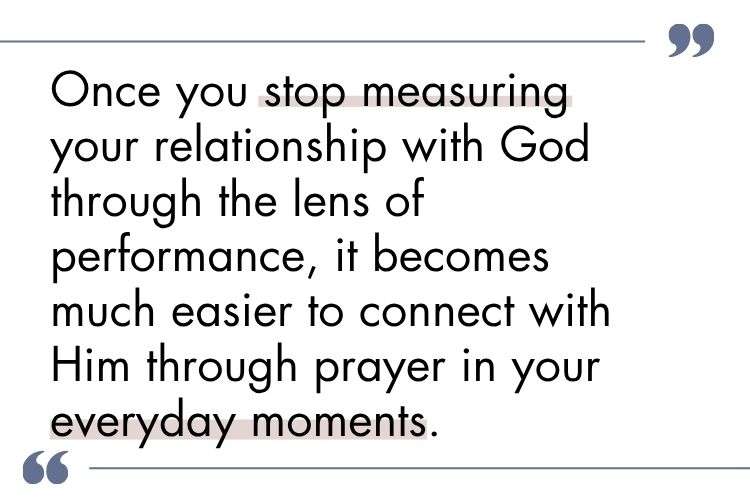
And once you stop measuring your relationship with God through the lens of performance, it becomes much easier to connect with Him through prayer in your everyday moments.
A Simple Prayer for Starting Over With God
If you’re not sure what to say the next time you come back, you don’t need a big speech. You can simply be honest.
Heavenly Father, it’s been a while, and You already know that. I’m tired of feeling like I have to make up for lost time before I can talk to You. Thank You that Your mercies are new this morning, too. Help me stop keeping score and simply come back to You today. Amen.
You can say more, of course. But you don’t have to.
Stop Starting Over and Start Building a Life of Prayer
You can keep trying new prayer routines, downloading reading plans, and promising yourself that this time will finally stick. But if you don’t change the way you’re approaching prayer, there’s a good chance you’ll find yourself right back where you started.
And that’s exactly what I want to help you change.
Because you don’t need another prayer routine that only works when life goes according to plan. You need to learn how to invite God into the middle of the life you’re already living.
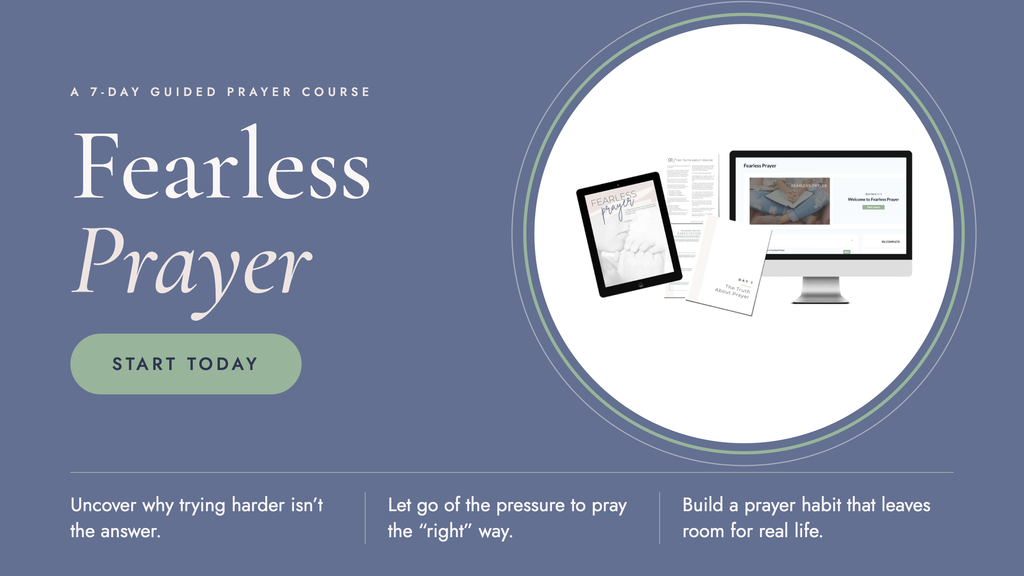
That’s why I created Fearless Prayer, my 7-Day Guided Prayer Course.
Over seven days, I’ll guide you through a different approach to prayer — one that helps you stop worrying about finding the right words, let go of the pressure to do everything perfectly, and begin talking to God with greater confidence.
You’ll learn how to move beyond treating prayer as something you have to fit into a perfect schedule and begin making prayer a part of your day.
You don’t need to keep starting over with another plan. It’s time to learn a different way to pray.
If You Keep Coming Back to God, You Haven’t Failed
As you begin to change the way you think about spending time with God, keep in mind that when you find yourself starting over again — and you will — the fact that you keep coming back doesn’t prove you’re failing.
It proves you haven’t quit. It shows that your desire for God is still there.
And even after the frustration, the guilt, and the disappointment, there’s still something inside of you that longs for a closer relationship with Him.
And that matters more than a perfect routine ever could.
So the next time you hear yourself say, “I’ll start again with God next week,” try this instead. Don’t wait for next week. Start with one honest sentence today.
And if you miss tomorrow? That’s okay. Simply come back.
You don’t have to become a woman who never starts over. You get to keep being a woman who comes back.
Frequently Asked Questions About Starting Over With God
Let’s take a moment to address the most common questions women are asking about spending time with God.
God’s Word is full of new beginnings. Lamentations 3:22–23 (NLT) says His mercies “begin afresh each morning,” which means starting over was built into your relationship with Him from the start. Coming back to God isn’t a sign of failure. It’s exactly what He invites you to do.
Yes. Many Christian women experience seasons where life becomes overwhelming and spiritual habits become inconsistent.
Struggling doesn’t mean you’re failing. It just means you need a different approach, not more effort.
No. God’s love for you isn’t based on perfect performance.
Throughout Scripture, we see Him continually invite His people back into relationship — even when they’ve wandered, struggled, or fallen short.
His invitation has always been “come,” not “come back when you’ve gotten it together.”
No. God isn’t measuring how much regret you feel before He’ll let you back in. When the prodigal son came home, his father saw him while he was still a long way off and ran to him before the son could finish the speech he’d rehearsed (Luke 15:20–22 NLT). An honest turn back toward God is enough to begin.
No. It’s never too late to come back to God, whether it’s been three days or thirty years. His faithful love never ends (Lamentations 3:22 NLT), and that includes the time you’ve been away.
Start small and focus on connection rather than perfection. Pray while folding clothes, loading the dishwasher, or driving to an appointment. Talk to God throughout your day instead of waiting for the “perfect” moment to sit down with Him.
Small, intentional moments with God can have a significant impact over time — especially when they’re built around honest relationship rather than the pressure to perform.

